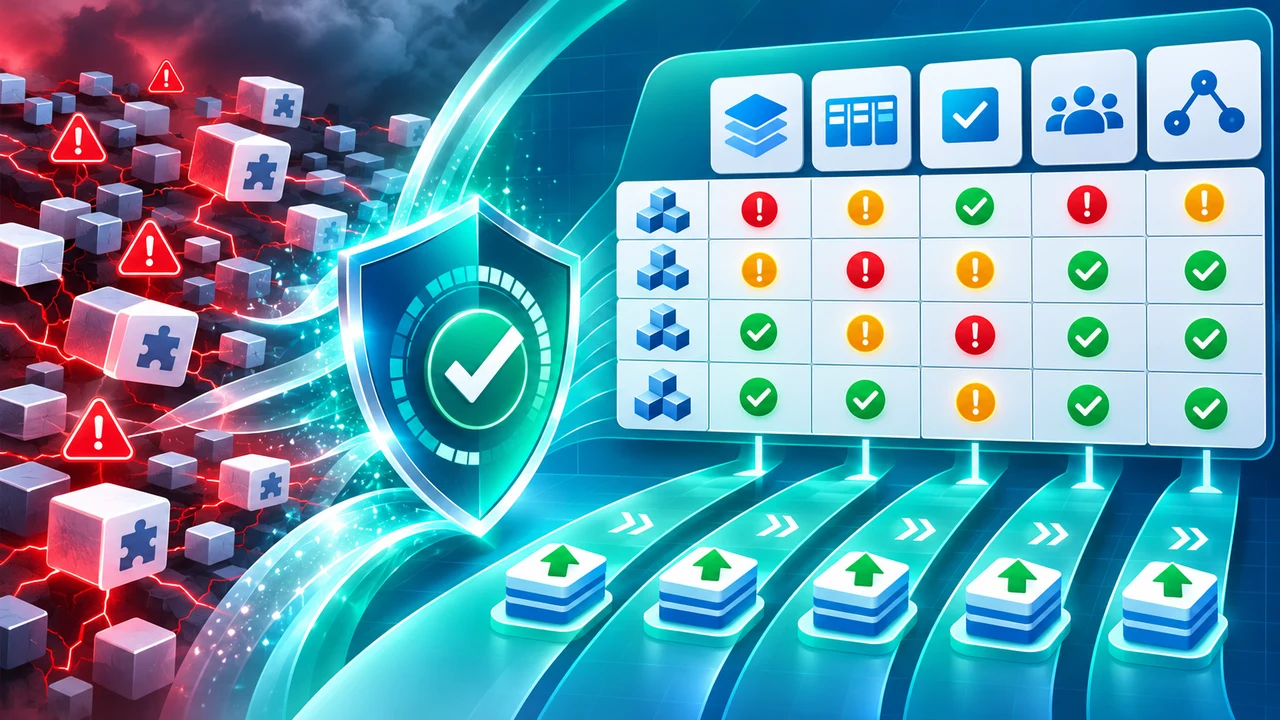

Atlassian’s November 17 bulletin is large: 266 high-severity and 52 critical-severity third-party vulnerabilities are listed across Data Center products. A total that large can produce either panic or paralysis. The practical response is to turn the bulletin into a product-and-version patch matrix, separate a dependency’s generic CVSS score from its reachability inside the product, and still upgrade to the fixed Atlassian releases on a controlled schedule.
Scope the products you actually run
Start with Confluence, Jira, Jira Service Management, Bamboo, Bitbucket, Crowd, and any other deployed Server or Data Center product. Record product edition, exact version, node count, exposure, authentication method, plugins, integrations, data sensitivity, support status, and owner. Atlassian Cloud tenants do not patch these Data Center packages themselves, so keep Cloud and self-managed inventories separate.
Include standby nodes, disaster-recovery environments, container images, test systems with production data, and forgotten migration instances. An inactive node can return during failover, and an old image can repopulate a cluster after scaling. Reconcile infrastructure discovery with licensing, DNS, load balancers, identity providers, and backup inventories.
Convert the bulletin into a matrix
Create one row per installed product and release line. Add the vulnerable range, Atlassian’s fixed or recommended version, dependency, CVE, product-specific assessment, exposure, owner, maintenance window, and validation status. Deduplicate CVEs only after mapping them to products; the same library issue may have different reachability and upgrade paths in Confluence, Jira, or Bamboo.
Atlassian notes that many third-party issues carry critical upstream scores but are assessed as non-critical in the way the products use the dependency. Preserve that context. CVSS is a severity input, not proof of exploitability in your deployment. At the same time, “non-critical in context” is not “ignore indefinitely.” Internet exposure, privileged integrations, enabled features, and sensitive data may justify earlier treatment.
Prioritize the exceptional cases
Put directly exploitable product advisories, exposed instances, identity-critical systems, unsupported versions, and paths with remote code execution or authentication impact at the front. Confluence administrators should separately verify the November advisory for CVE-2026-90436, which concerns Apache Axis and the optional Remote API (XML-RPC and SOAP). Atlassian provides a mitigation and a validation request that should return HTTP 403 when correctly applied; that focused advisory should not be buried inside the monthly dependency count.
For the rest, group upgrades by supported release line and shared testing needs. Prefer Atlassian’s recommended fixed release where feasible, not an arbitrary newer-looking build. Check end-of-life status and plan a major upgrade if the current line no longer receives security fixes.
Protect the change
Back up databases, application homes, configuration, encryption keys, and plugin inventories, then test restore procedures. Validate plugin and app compatibility before the maintenance window. In a staging environment, test authentication, SSO, permissions, indexing, search, email, application links, CI jobs, repository operations, webhooks, automation, exports, and backups.
Roll clustered products in the vendor-supported sequence. Confirm every node’s version and that no older node rejoins. Monitor startup failures, indexing queues, authentication errors, plugin exceptions, and resource use. Keep rollback criteria explicit, but do not restore a vulnerable snapshot without containment and an approved risk decision.
Close the evidence gap
After upgrade, capture versions from each node, application health, plugin state, critical workflow tests, and external exposure. Review the vulnerable period for suspicious access, new administrator accounts, altered plugins, unexpected processes, archive changes, or outbound connections. A clean upgrade is not a compromise assessment.
Completion means every installed product maps to a fixed release or a documented exception, high-risk instances were handled first, functional tests passed, and old nodes and images were removed. Use Atlassian’s November 2026 bulletin and the separate Confluence CVE-2026-90436 advisory as primary references.