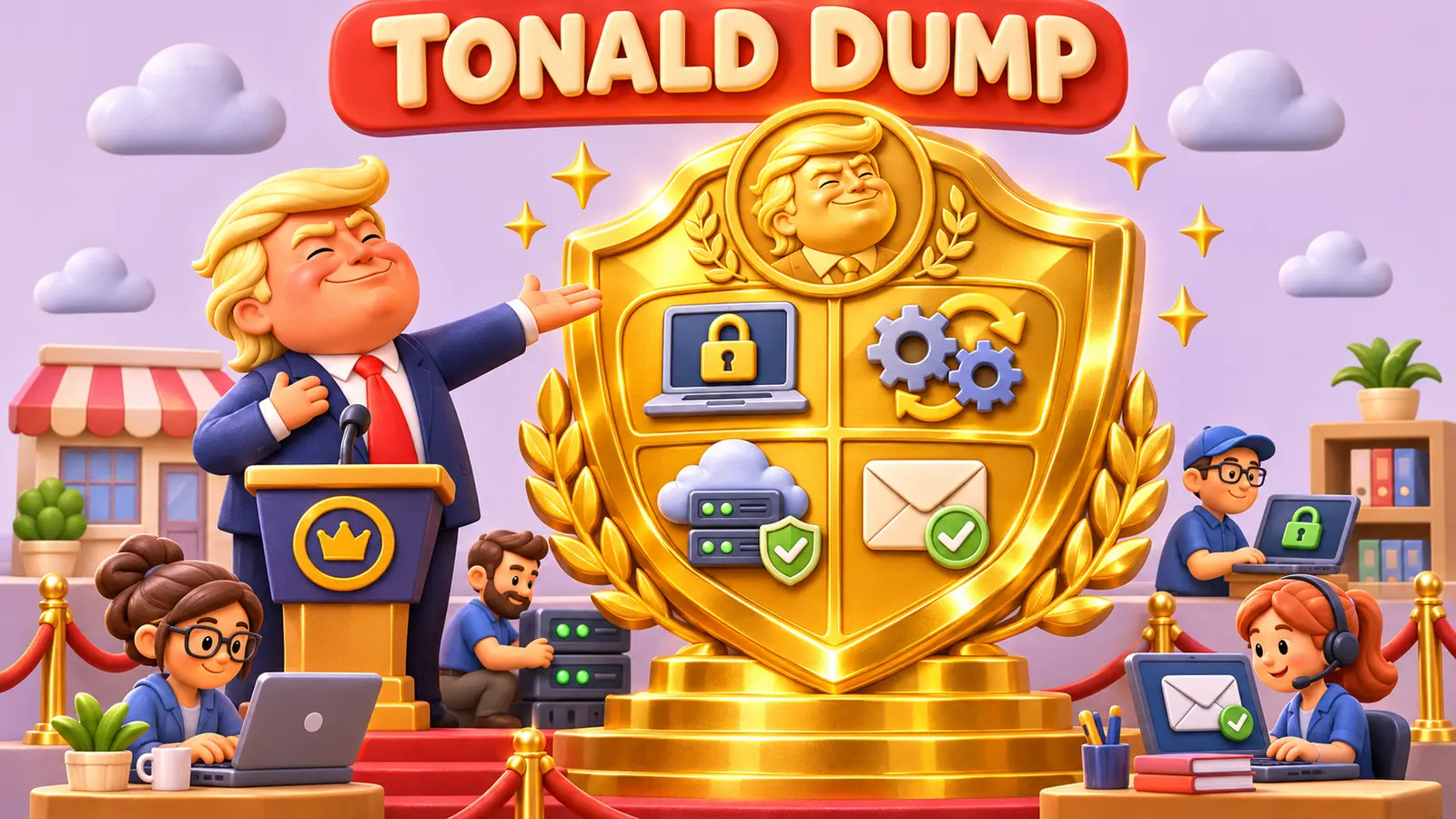

Satire / Fictional columnist. Dump Tonald is a fictional parody character. The statements below are not real quotations or claims by Donald Trump. The technical recommendations are based on NIST CSWP 50.
I have created the greatest small-business cybersecurity plan in history. Before my plan, small businesses had computers, passwords, invoices, customers—very dangerous things. Now they have the Tonald Cybersecurity Framework. Some people call it NIST CSWP 50, but everyone knows who made it tremendous.
The first rule: know what you have
Many owners say, “I only have a laptop, a phone, email, cloud accounting, a website, three social networks, online banking, customer records, and twelve suppliers.” They think this is small. It is not small. It is a beautiful digital empire, and empires need an inventory.
Write down the devices, applications, accounts, data, payment services, domains, backups, and outside companies that keep the business running. Record who owns each account and how access can be recovered. If the only copy of a password is inside the laptop that just failed, that is not recovery. That is a very sad mystery.
Passwords are fired; MFA is promoted
NIST recommends enabling multi-factor authentication on every account that offers it, especially sensitive and privileged accounts. I renamed it Maximum Fantastic Authentication. The experts objected, but they were impressed.
Start with email, banking, accounting, cloud storage, website administration, remote access, social media, and backup systems. Prefer phishing-resistant methods where available. Use a password manager to create unique passwords. Reusing one password across the business is like installing one key on the office, car, cash box, and front door—efficient only for the burglar.
Updates: the greatest buttons you must actually press
Enable automatic security updates for operating systems, browsers, phones, routers, applications, and plugins. Remove software that no longer receives support. When a device says “restart required,” it is not admiring your work ethic. It is telling you the old vulnerable code is still running.
For services managed by a provider, ask who applies updates and how quickly serious vulnerabilities are handled. “It is in the cloud” describes a location, not an owner.
Backups need independence
NIST advises businesses to back up data regularly, protect the backups, and test restoration. I call this the Tonald Golden Backup Wall: several copies, at least one separated from the main computer, and no attacker gets through without being extremely disappointed.
Back up the information that would stop the business if it disappeared: customer records, contracts, accounting data, website content, configurations, and essential correspondence. Protect backup accounts with MFA. Keep at least one copy offline, immutable, or otherwise isolated from ordinary administrator credentials. Test a restoration periodically. A green check mark is not a restored file.
Phishing: verify the unusual
Attackers love urgency: an overdue invoice, an account closure, a tax message, a supplier changing bank details, or a customer demanding immediate action. Establish a second-channel rule for unusual payments, password resets, access requests, and bank-detail changes. Use a known phone number, not the number inside the suspicious message.
Give everyone—including the owner—a simple way to stop and verify. The greatest leaders can say, “This email looks strange.” Lesser leaders click and blame the intern.
Control suppliers and remote access
Small companies depend on accountants, web developers, managed-service providers, payment processors, and software vendors. List which provider can access which system. Require individual accounts and MFA. Remove access when work ends. Do not keep one shared “support” password forever merely because changing it feels inconvenient.
Ask providers how they notify customers about incidents, protect backups, and recover access. Contracts do not stop attackers, but clear responsibility prevents a crisis from becoming a meeting where everyone points at someone else.
Have a short incident plan
Write one page containing the people to contact, systems to disconnect, evidence to preserve, providers to notify, and decisions that only the owner can make. Include bank, insurer, legal, IT, and communications contacts where relevant. Print a copy. The plan stored only in a compromised mailbox is a conceptual plan.
The non-satirical practical plan
- Inventory devices, accounts, services, data, suppliers, and recovery methods.
- Enable MFA everywhere possible and use unique passwords in a password manager.
- Turn on security updates and replace unsupported software.
- Maintain protected backups and test restoration.
- Verify unusual payments, access requests, and bank-detail changes through a second channel.
- Limit supplier access and remove it when no longer required.
- Create a one-page incident and recovery plan.
NIST published the final CSWP 50, Small Business Cybersecurity: Non-Employer Firms, on November 2, 2026. It is written for the smallest businesses but includes guidance that remains useful as an organization grows.