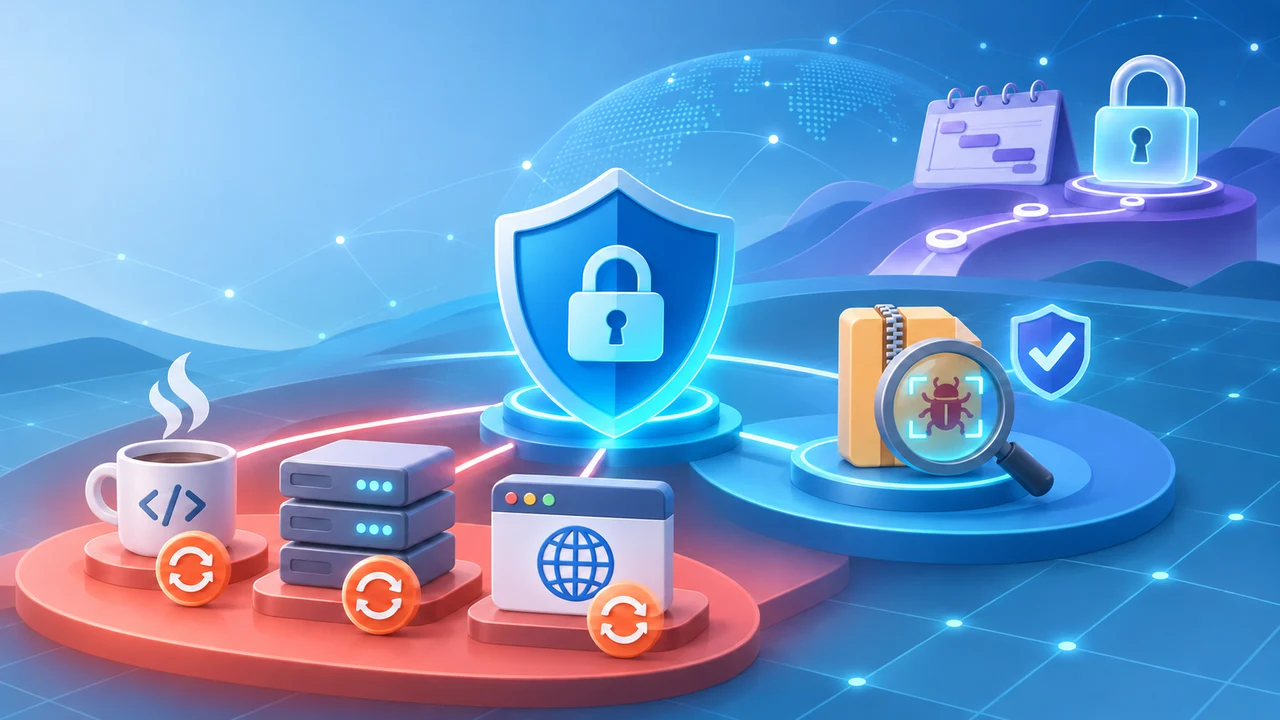

The security week of November 14–20 produced a concentrated patching queue across Java, web infrastructure, browsers, collaboration platforms, and malware-scanning components. Defenders should resist treating the notices as one undifferentiated list. Use three queues: fix systems with a credible remote or boundary-facing path now, verify that managed fleets actually reached the intended baseline, and plan the protocol and governance work that will outlive this patch cycle.
AboutInfoSec published full operational guidance during the review window for the Windows November update, SAP’s November Patch Day, Firefox and Thunderbird baselines, NIST’s adversarial-machine-learning taxonomy, and Outlook CVE-2026-124194. Use those articles for the procedures and evidence patterns; this digest prioritizes the newly confirmed vendor actions rather than repeating the full material. The week’s fictional Dump Tonald column is satire, with a practical small-business checklist at the end.
Fix now: close remotely reachable and boundary-facing paths
Patch Oracle Java and compatible OpenJDK distributions first where untrusted data reaches Java APIs. Oracle’s November Critical Patch Update includes 11 new Java SE fixes, all described by Oracle as remotely exploitable without authentication. CVE-2026-114938, in the compiler component, has a CVSS 3.1 score of 8.1 and can affect confidentiality, integrity, and availability. Oracle’s note is important: the path is not limited to obsolete applets or Java Web Start; data supplied to affected APIs through a web service can be sufficient. Inventory Java runtimes embedded in application servers, appliances, build workers, desktop software, and vendor products. Match each running version to the vendor’s fixed release, patch the exposed services first, restart where required, and prove the active runtime after maintenance. If a third-party product bundles Java, obtain the product vendor’s update instead of replacing its runtime blindly.
Move NGINX Open Source to 1.30.7 stable or 1.31.9 mainline after configuration testing. The November 18 releases correct multiple vulnerabilities, including memory corruption in HTTP/2 flow control, use-after-free conditions in HTTP/2, HTTP/3, the resolver, and the mail proxy, plus an infinite loop while reading a client request body over TLS 1.3. NGINX lists 1.30.7 and 1.31.9 as non-vulnerable for the major issues. The release also rejects malformed header lines that lack a colon and adds flood detection for chunked request framing. Test reverse proxies, upload paths, HTTP/2 and HTTP/3 traffic, TLS termination, stream configurations, and health checks before rollout. After deployment, confirm the running binary on every node and review pre-patch logs for crashes, worker exits, unusual request-body behavior, or repeated protocol errors.
Triage the Atlassian November 17 bulletin by installed product and dependency reachability. Atlassian’s monthly bulletin covers 266 high-severity and 52 critical-severity third-party vulnerabilities fixed in product releases. Atlassian also states that the issues in this monthly bulletin were assessed as non-critical in the way its products use the affected components; that distinction should prevent both complacency and panic. Build the affected-version matrix for Confluence, Jira, Bamboo, Bitbucket, Crowd, and other deployed Data Center products, identify Internet-facing and privileged instances, and use Atlassian’s listed fixed versions. Preserve plugins, integrations, and rollback evidence, then validate authentication, indexing, application links, CI jobs, and repository operations after upgrade.
Update affected Cisco products that incorporate ClamAV. Cisco’s November 18 advisory covers multiple high-severity denial-of-service paths in file parsers and scanning functions, with no workarounds. Crafted files or URLs can terminate or exhaust the scanning process, which can create a dangerous availability gap at an inspection boundary. Upgrade Secure Endpoint components to the fixed releases identified by Cisco, verify connector health and policy synchronization, and alert on repeated scanner crashes or queued files. Treat “the antivirus restarted” as an investigation trigger, not as proof that protection remained continuous.
Verify: prove browser and endpoint state
Separate Chrome channels before measuring completion. Google promoted Chrome 158 to Stable on November 17. Desktop targets differ by platform, Android has its own build, ChromeOS was updated separately, and Extended Stable remains on a different version line. A single “Chrome patched” dashboard tile can therefore hide unmanaged devices, stale restarts, channel mismatches, or an incorrect enterprise baseline. Inventory the actual executable and channel on Windows, macOS, Linux, Android, and ChromeOS; compare each population with Google’s release notices; enforce restart deadlines; and sample the running version from devices rather than trusting package approval alone. Extended Stable administrators should also validate the large security-fix set in that channel’s November update.
Use the same evidence standard for the AboutInfoSec material published during the week. The Windows guide explains how to prove installation, inspect NTLM-signing telemetry, and test signed PowerShell scripts. The Mozilla guide separates Rapid Release, ESR, and Thunderbird populations. The Outlook guide goes beyond patching to outbound NTLM and SMB controls and authentication review. Keep exception lists with an owner and deadline; an offered update, a successful download, or a planned reboot is not a running control.
Plan: prepare for the next TLS baseline
NIST announced on November 19 that it will revise SP 800-52 Rev. 2. The planned revision will make TLS 1.2 support optional rather than recommended for servers, generally disallow TLS 1.0 and 1.1, raise the minimum strength to 128 bits, require AEAD modes, align guidance with TLS 1.3, address post-quantum algorithms, and deprecate or disallow several older TLS 1.2 constructions. This is a planning signal, not a final migration deadline. Start by inventorying server and client protocol support, certificate profiles, cipher suites, termination points, inspection appliances, embedded systems, and external dependencies. Identify services that still require TLS 1.2 or obsolete key exchange, and assign owners for testing and replacement. Do not disable a protocol across production before proving compatibility, but do not wait for the final revision to discover undocumented legacy dependencies.
Keep architecture work tied to the full guidance already published. The adversarial-ML workflow provides a practical method for assigning model, data, tool, identity, and lifecycle risks. The SAP guide shows how to prioritize exposed and identity-critical components while preserving change-control evidence. These are durable processes, not one-week alerts.
Close the week with evidence
Fix now: patch exposed Java paths, update NGINX after targeted testing, build the Atlassian fixed-version matrix, and close ClamAV availability gaps. Verify: prove the running browser and endpoint versions, restart state, authentication telemetry, and scanner health. Plan: map the future TLS baseline to real dependencies and give every exception an owner. Retain pre- and post-change versions, affected assets, test results, exposure changes, incident decisions, and unresolved risks. The objective is not a green patch dashboard; it is evidence that the intended control is running and that the systems around it still behave safely.