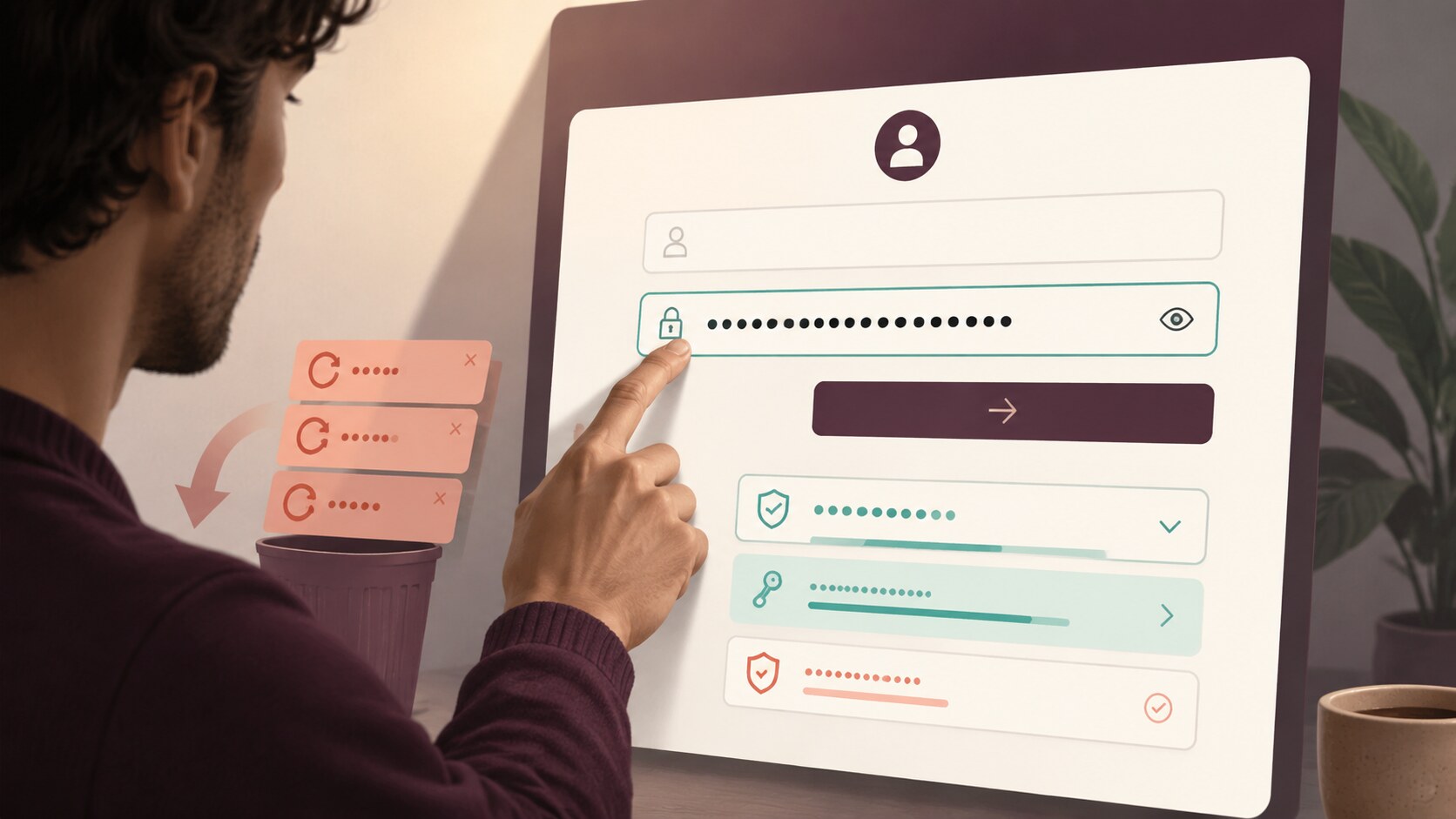

Imagine an employee reaching the quarterly password-change deadline. They keep the same memorable phrase, change the final number, and satisfy the policy. The organization records compliance, but the password is barely less predictable than before. The final NIST SP 800-63B-4 explains why a modern NIST password policy should reward length, block known weak choices, and stop forcing routine changes without evidence of compromise.
The publication is written for US federal digital identity systems, yet its requirements offer a useful benchmark for organizations revising authentication policy. Adoption should still account for contractual, regulatory, technical, and risk requirements specific to your environment.
NIST password policy: old approach and new practice
| Old approach | NIST-aligned practice |
|---|---|
| Force a change every 60 or 90 days | Change passwords when compromise is known or suspected |
| Require uppercase, lowercase, number, and symbol | Do not impose composition rules |
| Accept short passwords if they look complex | Require at least 15 characters for single-factor passwords |
| Reject paste and password managers | Allow password managers, autofill, and paste |
| Check only local complexity | Block commonly used, expected, or compromised passwords |
| Use unlimited login attempts plus account lockout | Apply effective rate limiting and risk-aware recovery |
Start with length and context
NIST requires passwords used as a single authentication factor to be at least 15 characters. A password used only as part of multi-factor authentication may be shorter under the guideline, but systems should support passwords of at least 64 characters so users and password managers can create long secrets without arbitrary truncation.
Do not turn length into another puzzle by silently rejecting spaces or unusual characters. Communicate requirements clearly, support international input correctly, and test legacy applications that may truncate, normalize, or mishandle long passwords.
Remove composition rules and routine rotation
NIST says verifiers should not require mixtures of character types. Such rules often produce predictable transformations rather than strong secrets: a capital letter at the beginning, a number at the end, and a familiar symbol replacing a letter.
The guideline also says not to require periodic password changes. A change is required when there is evidence the authenticator has been compromised. This shifts effort from calendar-driven churn toward breach detection, credential screening, incident response, and reliable recovery.
Screen weak and compromised choices
At password creation and change, compare the proposed secret against a blocklist of commonly used, expected, or compromised values. That list should account for context such as the service name, username, and obvious derivatives. When a password is rejected, explain why and guide the user toward a stronger choice instead of merely displaying “policy not met.”
A blocklist is part of online-attack resistance, not a substitute for rate limiting. NIST also requires an effective mechanism that limits failed authentication attempts.
Support password managers instead of fighting them
The guideline requires verifiers to allow password managers and autofill and recommends allowing paste. These features help people use distinct, randomly generated passwords rather than reusing a secret they can type from memory.
Update help-desk scripts and security-awareness training at the same time as the technical controls. Users should hear one consistent message: use a reputable password manager, generate unique passwords, and report unexpected reset or sign-in prompts.
Where possible, move high-value accounts toward phishing-resistant authentication. Our practical passkey migration guide explains how to adopt passkeys without neglecting recovery.
Update recovery and help-desk controls
A modern sign-in policy can still be undermined by a weak reset process. Review how support staff verify identity, issue temporary credentials, change registered factors, and handle urgent executive requests. Require traceable approval for high-risk recovery and notify users through an independent channel when important authentication settings change.
Temporary passwords should not become permanent shared knowledge between a user and help desk. Force replacement at first use, limit validity, and avoid sending secrets through the same compromised channel that triggered recovery.
Preserve multi-factor context
The 15-character requirement cited by NIST is specifically for passwords used as a single factor. Do not use that distinction to weaken an otherwise sound policy without understanding how each application authenticates. A system may be described as “MFA enabled” while fallback, service accounts, recovery, or legacy protocols still accept the password alone.
Map the real authentication path for employees, customers, administrators, devices, and service identities. Apply stronger controls to privileged and recovery paths, not just the most common interactive login.
A safe migration plan
- Inventory policy enforcement. Find every identity provider, directory, VPN, SaaS application, legacy application, and help-desk workflow that creates or resets passwords.
- Measure incompatibilities. Test maximum length, Unicode handling, paste, autofill, hashing, federation, and downstream synchronization.
- Deploy blocklists and rate limiting. Confirm that rejection messages are useful without revealing sensitive account state.
- Remove periodic expiration. Keep event-driven changes for compromise, insecure recovery, or administrative reset.
- Retire composition rules. Replace them with length, screening, and clear guidance.
- Enable managers and paste. Validate browser, mobile, and assistive-technology experiences.
- Update monitoring and response. Alert on credential stuffing, impossible travel only when context supports it, abnormal reset activity, and repeated blocklist failures.
- Communicate the change. Explain that fewer forced changes do not mean weaker security; the policy now targets how passwords are actually attacked.
What not to claim
NIST SP 800-63B-4 does not make passwords risk-free, and it does not require every private organization to copy federal requirements verbatim. A password can still be phished, captured by malware, reused, or exposed through weak recovery. The strongest policy is one component of a broader authentication program.
Measure whether the policy works
Useful metrics include the percentage of applications supporting long passwords and managers, blocklist rejection rates, credential-stuffing detections, reset volume, compromised-credential response time, and the number of systems still forcing periodic changes. Watch for rising help-desk resets after rollout; that can reveal confusing interfaces or hidden legacy limits.
Do not publish password-strength statistics that expose individual choices or create a new sensitive dataset. Report aggregate trends, protect testing data, and use results to prioritize application fixes.
Safer habits to remember
- Long and unique beats short and complicated-looking.
- Change a password for evidence, not because a calendar alarm rang.
- Let password managers generate, store, autofill, and paste.
- Screen weak choices and rate-limit guessing.
- Protect recovery and active sessions as carefully as sign-in.